SEC Proposes Rule Allowing Semiannual Reporting: Highlights and Takeaways
May 7, 2026
On May 5, 2026, the Securities and Exchange Commission (the SEC) released its proposed rule on Semiannual Reporting that, if adopted, would permit public companies to report on a semiannual, rather than quarterly, basis (the Proposed Rule). The Proposed Rule has been a priority of President Trump and SEC Chair Paul S. Atkins since September 2025,1 and the Proposed Rule is the first major rollback of disclosure requirements under SEC Chair Paul S. Atkins’s leadership of the SEC.
In his Statement on Proposing Release for Semiannual Reporting, Chair Atkins praised the work of the SEC staff and placed the Proposed Rule in the context of the SEC’s broader efforts to “incentiviz[e] companies to go and stay public.”
Optional Semiannual Reporting on New Form 10-S
Under the Proposed Rule, companies that are currently required to file Quarterly Reports on Form 10-Q pursuant to Rule 13a-13 and Rule 15d-13 under the Securities Exchange Act of 1934, as amended (the Exchange Act), would have the option to instead file a Semiannual Report on Form 10-S.
The new Form 10-S would require the same narrative disclosures and financial information as the existing Form 10-Q, but the disclosures would cover a semiannual, rather than quarterly, period. The new Form 10-S would be due within 40 or 45 days (depending on the company’s filer status) after the end of the company’s applicable interim semiannual period, consistent with the current timing requirements for Form 10-Q.
Companies wishing to report on a semiannual basis (Semiannual Filers) would indicate their intent to do so with a new check box on the cover page of their Annual Report on Form 10-K. The election to file on a quarterly or semiannual basis would then apply to the company’s entire fiscal year in which the Form 10-K with the election was filed and may only be changed by checking (or unchecking) the relevant box in the Form 10-K filed in the next fiscal year. Companies that mistakenly leave the check box unmarked or incorrectly mark the check box may amend their Form 10-K to correct the inadvertent mistake by filing a corrective amendment to the Form 10-K as soon as practicable, but no later than the due date otherwise applicable to the company’s first fiscal quarter Form 10-Q.
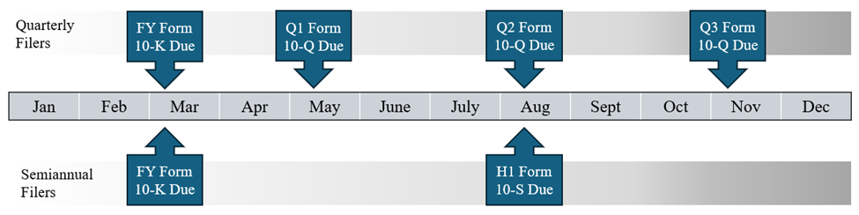
Proposed Filing Cadence for December 31 Fiscal Year End Large Accelerated Filer (Quarterly and Semiannual)
Although companies may freely switch from semiannual to quarterly reporting from year to year, under the Proposed Rule, a company switching from semiannual to quarterly reporting would be required to present in its Form 10-Q year-over-year quarterly comparisons of “statements of comprehensive income, cash flows, and changes in stockholder’s equity,” which they may not readily have if these were not prepared for quarters in which reporting was not required. Companies that elect to switch to semiannual reporting and then back to quarterly reporting may therefore “need to take additional steps to prepare the financial statements” for comparable quarterly periods.2
The SEC also proposed adding the check box to the cover page of registration statements filed under the Exchange Act or the Securities Act of 1933, as amended (the Securities Act).
Conforming Amendments to Form 8-K, Regulation S-K, and
Regulation S-X
The Proposed Rule includes technical amendments to a number of Securities Act and Exchange Act rules and forms to incorporate provisions applicable to companies that elect semiannual reporting. These include, for example:
- adding “quarterly filer” and “semiannual filer” as new definitions under Rule 12b-2 of the Exchange Act and Rule 405 under the Securities Act and incorporating the new terms into all relevant Exchange Act and Securities Act rules and forms;
- amending Form 10-K and Securities Act and Exchange Act registration statements to include the check box indicating a filer’s reporting cadence; and
- amending several provisions of Regulation S-X to, among other things, ensure that when Semiannual Filers file registration statements, their financial statements in those registration statements are not considered “stale.”
SEC Soliciting Comments on Necessary Changes to Accounting and Auditing Standards and Exchange Rules
The SEC acknowledged that many auditing and accounting standards and stock exchange rules were drafted assuming that all public companies would be filing quarterly reports. In connection with the Proposed Rule, the SEC is soliciting comments on “what changes to accounting or auditing standards or rules of securities exchanges should be made to comport with semiannual reporting.”3
Other Comments Solicited by the SEC
The SEC is also soliciting comments on a variety of topics related to semiannual reporting in the Proposed Rule, including but not limited to:
- whether the SEC should allow companies to elect quarterly or semiannual reporting, as proposed, or require all companies to file at the same frequency;
- whether the option for semiannual reporting should be available for all companies, as proposed, or only for reporting companies that satisfy certain criteria;
- whether the deadlines for semiannual reporting should be the same as for quarterly reporting, as proposed, or whether the deadlines should differ;
- whether and how semiannual reporting may impact an investor’s ability to compare same-company performance and relative peer company performance over time;
- whether providing a check box for reporting elections on the cover page of the Form 10 K, as proposed, provides investors sufficient notice of a company’s intended filing cadence, or whether earlier notice would be beneficial;
- whether the SEC should require companies to adhere to their reporting frequency for the entire fiscal year in which the election was first indicated, as proposed, or whether they should be allowed to switch frequency during the fiscal year;
- whether the new Form 10-S should require the same narrative and financial disclosures as Form 10-Q, as proposed, or whether there is any information that should differ between Form 10-S and Form 10-Q;
- whether, as an alternative to semiannual reporting on Form 10-S, as proposed, the SEC should instead revise the disclosure requirements of Form 10-Q (and if so, what revisions may be warranted);
- whether the option for semiannual reporting would result in an overall reduction in material information for investors;
- whether Semiannual Filers would still retain an independent public accountant to perform a review of their financial statements at the end of each quarter;
- whether the SEC should require Semiannual Filers to include second semiannual period financial information in the Form 10-K; and
- whether and to what extent the switch to semiannual reporting would have an impact on a company’s blackout periods under their insider trading policy.
Considerations for Public Companies Considering a Move to Semiannual Reporting
Though SEC Commissioner Mark T. Uyeda has in public statements highlighted that semiannual reporting would be most relevant for certain types of companies (e.g., pre-revenue life sciences companies with a single product in the pipeline),4 the Proposed Rule (if adopted as proposed) would make semiannual reporting available to all public companies.
Companies should keep the following in mind when considering whether semiannual reporting may be in their best interest if the Proposed Rule is adopted:
- Market Expectations and Peer Behavior. Expectations of analysts, investors, and other market participants may influence a company’s decision whether to report on a quarterly or semiannual basis. As market participants currently expect quarterly reporting for most companies, there is uncertainty about what market response may be to a reduced reporting cadence. Industry and peer practices will likely impact a company’s decision-making.
- Capital Raising Impact. A company’s decision on the appropriate reporting cadence may depend on its need to access the capital markets, as it will need to ensure that all material information is disclosed before the company can access those markets. There remains uncertainty whether a hybrid reporting scheme (i.e., semiannual reporting with enhanced voluntary quarterly disclosures) will address these concerns, and at what cost to the company. Even with enhanced disclosures, Semiannual Filers may face reduced liquidity and valuation and increased volatility, which may adversely impact their access to capital. With respect to debt financing in particular, a company may also be subject to contractual requirements to provide counterparties with quarterly financial and other updates, which are currently satisfied by filing quarterly reports.
- Heightened Focus on Form 8-K Disclosures. A company should consider whether moving to semiannual reporting could result in increased pressure for the company to disclose material information on Form 8-K due to the long period elapsed between semiannual filings. A failure to properly disclose material financial and nonfinancial information during these interim periods could result in, among other things, reduced access to capital, increased risks under Regulation FD, insider trading laws, or disclosure rules, and increased risk of shareholder lawsuits. A company may need to consider enhancing its disclosure controls and procedures to ensure that material information is properly disclosed in the period elapsed between filings. The SEC is also soliciting comment on whether further changes to Item 2.02 of Form 8-K are warranted for Semiannual Filers, including whether Semiannual Filers should be required to “file” rather than “furnish” the Item 2.02 earnings release, which would “subject the earnings release to additional liability provisions.”5
- Insider Trading and Blackout Windows. A company should consider what impact semiannual reporting would have on its trading windows under its insider trading policies and procedures, and whether a switch to semiannual reporting would result in fewer available trading days for company insiders.
- Impact on Compliance Costs Uncertain. A company should consider to what extent the costs saved by eliminating two quarterly filings are offset by an increase in compliance costs required to mitigate any risks created by the new filing cadence, including but not limited to the need for additional disclosure controls and procedures to ensure material nonpublic information is timely reported, the potential for additional Form 8-K disclosures throughout the year, and increased complexity of audit firm reviews covering extended periods.
Next Steps
Comments on the Proposed Rule are due on or before July 6, 2026.
Although the Proposed Rule would only reduce the disclosure cadence and not reduce any of the underlying disclosure requirements, Chair Atkins has indicated in public statements that further reforms to Regulation S-K are forthcoming.6
1 Paul S Atkins, Chair, Sec. & Exch. Comm’n, Opinion, Let the market decide how often companies report, FINANCIAL TIMES, Sep. 28, 2025, https://www.ft.com/content/0f6be08a-fd244558-b373-6ada31e18900.
2 Semiannual Reporting, Securities Act Release No. 11,414, Exchange Act Release No. 105,368, Investment Company Act Release No. 36,140 91 Fed. Reg. 24968 (proposed May 5, 2026),https://www.sec.gov/files/rules/final/2025/33-11377.pdf [hereinafter Proposed Rule] at 29.
3 Id. at 24.
4 Mark T. Uyeda, Comm’r, Sec. & Exch. Comm’n, Statement on Proposing Semiannual Reporting (May 5, 2026), https://www.sec.gov/newsroom/speeches-statements/uyeda-statement-proposing-semiannual-reporting-050526 (“An established pharmaceutical company with a trillion-dollar market capitalization is markedly different from a pre-revenue biotech company pursuing approval of a single drug candidate…For the former, quarterly financial developments may signal underlying business changes, whereas for the latter, the key information may relate to the successful scientific development and FDA approval of the drug.”); Mark T. Uyeda, Comm’r, Sec. & Exch. Comm’n, Remarks at the 2025 Institute for Corporate Counsel (Dec. 3, 2025), https://www.sec.gov/newsroom/speeches-statements/uyeda-remarks-institute-corporate-counsel-120325 (“For companies with a multi-year development cycle, such as those who have a single product in the pipeline and no current revenue, shareholders may find quarterly financial information less relevant than disclosure on the progress towards development milestones.”).
5 Proposed Rule at 38.
6 Paul S Atkins, Chair, Sec. & Exch. Comm’n, Opinion, Statement on Reforming Regulation S-K (Jan. 13, 2026), https://www.sec.gov/newsroom/speeches-statements/atkins-statement-reforming-regulation-s-k-011326.
This memorandum is a summary for general information and discussion only and may be considered an advertisement for certain purposes. It is not a full analysis of the matters presented, may not be relied upon as legal advice, and does not purport to represent the views of our clients or the Firm. Shelly Heyduk, an O’Melveny partner licensed to practice law in California; Rob Plesnarski, an O’Melveny partner licensed to practice law in the District of Columbia; Andra Troy, an O’Melveny partner licensed to practice law in New York; Ashley Gust, an O’Melveny counsel licensed to practice law in New York; Aliza Cohen, an O’Melveny resource attorney licensed to practice law in California; Chloe Keedy, an O’Melveny associate licensed to practice law in California; and Kate Jones, an O’Melveny associate licensed to practice law in California, contributed to the content of this newsletter. The views expressed in this newsletter are the views of the authors except as otherwise noted.
© 2026 O’Melveny & Myers LLP. All Rights Reserved. Portions of this communication may contain attorney advertising. Prior results do not guarantee a similar outcome. Please direct all inquiries regarding New York’s Rules of Professional Conduct to O’Melveny & Myers LLP, 1301 Avenue of the Americas, Suite 1700, New York, NY, 10019, T: +1 212 326 2000.