As Tariffs Rise and Enforcement Intensifies, The False Claims Act Poses Increasing Risks for Importers and Their Partners
January 23, 2026
As tariff rates climb and trade enforcement intensifies, the False Claims Act (FCA) is emerging as a significant—and often overlooked—risk for importers and their business partners. Companies navigating today’s volatile tariff landscape face not only customs penalties, but also the prospect of treble damages and whistleblower-driven FCA actions tied to alleged tariff evasion. Recent DOJ guidance and enforcement activity make clear that customs fraud and trade violations are now a priority area for FCA scrutiny. Understanding how import practices intersect with FCA liability is essential for companies seeking to manage risk in this new enforcement environment.
Key Takeaways
- Heightened Damages Exposure. Rising tariffs significantly increase potential FCA damages tied to undervaluation, misclassification, or false country-of-origin declarations.
- DOJ Enforcement Focus. DOJ has explicitly identified tariff evasion and customs fraud as enforcement priorities and expanded whistleblower incentives in this space.
- Growing Enforcement Track Record. Since 2020, DOJ has resolved dozens of FCA matters involving alleged customs and duties evasion—most initiated by relators.
- Geographic Enforcement Trends. Imports from China have been a particular focus, but heightened enforcement risk applies across jurisdictions as tariff rates fluctuate.
- Mitigating FCA Risk. Proactive compliance, accurate documentation, and experienced FCA and trade-law counsel are critical to mitigating exposure.
While companies and investors riding the “Tariff Roller Coaster” are keenly aware of changing tariff schedules and increased scrutiny from the Bureau of Customs and Border Protection (CBP), the risk of False Claims Act (FCA) liability may not be top of mind. However, in this new tariff environment, companies should expect increased FCA activity from both DOJ and relators and—given the higher tariffs—significant potential damages for FCA violations.
The False Claims Act and Import Law Violations
The False Claims Act is the government’s “primary civil tool to redress false claims for federal funds and property involving government programs and operations.”1 Any entity that does business, directly or indirectly, with the government can be held liable for submitting or causing the submission of a false or fraudulent claim for payment or for knowingly and improperly avoiding an obligation to pay the government.2 Companies can be liable if they acted with reckless disregard or deliberate ignorance, even if they do not have direct knowledge of a false or fraudulent claim.3 As such, companies that fail to pay tariffs, customs, or duties—even unintentionally—may trigger FCA liability in addition to the penalties provided for in the relevant tariffs, customs, and duties regulatory frameworks.
A defendant found liable under the FCA faces steep damages, including civil penalties of $14,308 to $28,619 for each false claim and treble damages.4 In Fiscal Year 2024 alone, the government recovered $2.6 billion in FCA settlements and judgments.5 Often FCA cases are initiated by private individuals, or “relators,” who act as “whistleblowers” under the Act’s qui tam provision and share in any recovery.6 The risk exposure for importers and those doing business with them has grown significantly as tariff rates and FCA enforcement have risen.
The Trump Administration Has Identified Tariff Evasions as an Enforcement Priority
In a memorandum from DOJ entitled “Focus, Fairness, and Efficiency in the Fight Against White-Collar Crime” issued on May 12, 2025, the Criminal Division signaled a renewed, outcomes‑driven emphasis on high‑impact corporate enforcement in trade and customs fraud, including tariff evasion, as priority areas under its pillars of “Focus, Fairness, and Efficiency.” Aligned with these priorities, DOJ also expanded its Corporate Whistleblower Awards Pilot Program to cover tips leading to forfeiture in trade, tariff, and customs fraud matters.
Consistent with those developments, in his February 20, 2025 keynote address at the Federal Bar Association’s annual qui tam conference, then-Deputy Assistant Attorney General Michael Granston emphasized the role of the FCA in rooting out “illegal foreign trade practices" and reiterated DOJ will “continue to use the False Claims Act to enforce these trade laws.” The Director of DOJ’s Civil Fraud Section, Jamie Ann Yavelberg, echoed these comments, explaining that customs and tariff evasion would be a “key area” for enforcement. Importers should thus expect increased scrutiny of their compliance with trade laws and FCA enforcement where that compliance falls short in the eyes of DOJ or relators.
Trends in Prior FCA Tariff Enforcement
While the Administration’s prioritization of customs and tariff enforcement is notable, the use of the FCA in this area is not new. Since 2020, DOJ has publicly resolved at least thirty-five FCA cases involving alleged customs and duties evasion. Over 85% of these cases were qui tam suits, which suggests that the FCA relators’ bar is ready and willing to answer the Administration’s call to use the FCA to pursue trade law violations.
Additionally, the vast majority of cases involved imports from China, and this enforcement trend is likely to continue given the Administration’s focus on Chinese imports and high-tariff rates on Chinese goods. Companies importing from China should thus exercise increased caution. However, given the increased and rapidly changing tariff rates across dozens of countries, importers transacting with any country should be cognizant of enforcement risk and ensure their practices are thoroughly vetted, appropriately strengthened, and promptly implemented.
Most of these cases concerned alleged undervaluing of imported goods, particularly through the use of double-invoicing schemes where an importer paid for the goods through one set of true invoices, while providing CBP a separate set of invoices that undervalued the product.7 Increased scrutiny of documentation and use of data analytics tools by CBP will likely continue to yield FCA suits involving undervaluation.8 Additionally, import misclassification is a growing focus of enforcement.9 Given rising tariff rates, DOJ and relators are likely to pay special attention to changes in importers’ practices regarding the classification of goods, especially when such changes coincide with changes in the tariff schedule. And the potential penalties for such violations are significant. For example, Ceratizit USA LLC, a North Carolina-based distributor of tungsten carbide products, recently paid $54.4 million—the largest-ever such settlement—to resolve FCA liability for alleged customs duties evasion.10 Notably, the settlement covered conduct from 2020 to 2024, so this record-breaking settlement resulted from the relatively lower tariffs of the previous administration. Potential damages exposure—and future settlement amounts—are likely to only increase with heightened tariffs.
Increasing Tariff Rates Will Likely Result in Dramatically Higher Damages in FCA Actions
The Trump Administration has dramatically changed tariff policy. Tariffs on imports from U.S. trading partners are several times higher than the prior average 3.3% rate, and there is uncertainty about whether these current rates will change over the course of ongoing bilateral negotiations and in the face of numerous legal challenges, including one significant challenge that is before the Supreme Court and which is expected to be decided imminently.
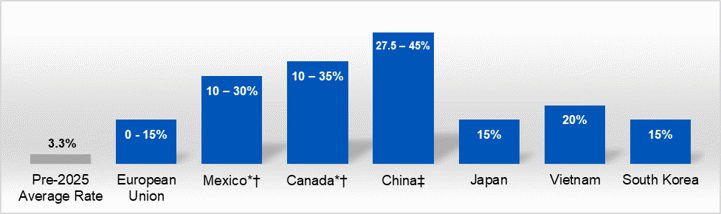
Against the backdrop of the Administration’s stated emphasis on pursuing tariff evaders, importers face amplified exposure under both customs laws and the FCA. As tariff rates increase—particularly where country-specific rates are elevated—the potential duty shortfall from misclassification, undervaluation, or false country-of-origin declarations rises proportionately. For example, imagine an importer who, on the day of the April 10, 2025 tariff announcement, knowingly mislabeled a $100 item as coming from Canada—where the baseline tariff rate was 10%—when it actually was from China—where the baseline tariff rate was 125%. The company may be liable for the difference of $115, which when trebled, amounts to $345 in damages per item. In a shipment of 1000 items, the damages would be $345,000. These historically high tariff rates will likely result in dramatically higher damages. And recent enforcement pronouncements explicitly prioritizing customs fraud and tariff evasion and the expansion of whistleblower programs further increases the likelihood that the government will investigate and prosecute suspected noncompliance.
Assessing Exposure, Ensuring Compliance, and Navigating Enforcement Actions Requires FCA and Trade-Law Expertise
Given the evolving tariff landscape, importers should reassess their compliance programs and exercise heightened diligence in implementing and monitoring their risk-management practices, especially when importing from China. Proactive measures—such as ensuring accurate invoicing, proper classification, and transparent communication with the government—are essential to mitigating the risk of FCA liability. Counsel with deep subject-matter expertise and FCA enforcement experience will be critical for companies seeking to manage their risks and navigate any resulting investigations and litigation.
1 See Press Release, Deputy Attorney General Lisa O. Monaco Announces New Civil Cyber-Fraud Initiative, DOJ (Oct. 6, 2021), available at https://www.justice.gov/archives/opa/pr/deputy-attorney-general-lisa-o-monaco-announces-new-civil-cyber-fraud-initiative.
2 31 U.S.C. § 3729(a).
3 31 U.S.C. § 3729(b)(1)(A).
4 31 U.S.C. § 3729(a).
5 Press Release, False Claims Act Settlements and Judgments Exceed $2.9B in Fiscal Year 2024, DOJ (Jan. 15, 2025), available at https://www.justice.gov/archives/opa/pr/false-claims-act-settlements-and-judgments-exceed-29b-fiscal-year-2024.
6 31 U.S.C. § 3730; Press Release, False Claims Act Settlements and Judgments Exceed $2.68 Billion in Fiscal Year 2023, DOJ (Feb. 22, 2024), available at https://www.justice.gov/opa/pr/false-claims-act-settlements-and-judgments-exceed-268-billion-fiscal-year-2023.
7 See, e.g., Complaint at 7–8, United States ex rel. Kohlenberger v. Yogibo LLC., No. 22-cv-10004-IT (D. Mass. Jan. 3, 2022); Complaint at 4–5, United States ex rel. Lahijani v. Delta Uniforms Inc., No. 19-cv-03290-PGG (S.D.N.Y. Sept. 24, 2021).
8 United States Customs and Border Protection – AI Use Cases, CBP (Dec. 16, 2024), available at https://www.dhs.gov/ai/use-case-inventory/cbp (describing deployment phase of Advanced Trade Analytics Program, which allows “CBP personnel to examine the information as part of detecting and deterring non-compliance throughout the trade environment”); see United States ex rel. Customs Fraud Investigations, LLC. v. Victaulic Co., 839 F.3d 242, 247–48 (3d Cir. 2016).
9 See, e.g., Complaint at 7, United States v. Repwire LLC, No. 24-cv-00173 (Ct. Int’l Trade Sept. 10, 2024); Complaint at 6–7, United States ex rel. Taylor v. GMI Corp., No. 16-cv-07216-RWL (S.D.N.Y. Feb. 14, 2023).
10 Press Release, Ceratizit USA LLC Agrees to Pay $54.4M to Settle False Claims Act Allegations Relating to Evaded Customs Duties, DOJ (Dec. 18, 2025), available at https://www.justice.gov/opa/pr/ceratizit-usa-llc-agrees-pay-544m-settle-false-claims-act-allegations-relating-evaded-0.
* Excluding USMCA-eligible items
† Steel and aluminum reciprocal tariff at 50%
‡ China-specific rates; does not include other global tariffs
This memorandum is a summary for general information and discussion only and may be considered an advertisement for certain purposes. It is not a full analysis of the matters presented, may not be relied upon as legal advice, and does not purport to represent the views of our clients or the Firm. Amanda M. Santella, an O’Melveny partner licensed to practice law in the District of Columbia and Maryland; Greta L. Nightingale, an O’Melveny partner licensed to practice law in the District of Columbia; Hannah E. Dunham, an O'Melveny counsel licensed to practice law in California and the District of Columbia; Hannah V,L. George, an O'Melveny associate licensed to practice law in the District of Columbia; and Nathan Tschepik, an O’Melveny associate licensed to practice law in the District of Columbia, contributed to the content of this newsletter. The views expressed in this newsletter are the views of the authors except as otherwise noted.
© 2026 O’Melveny & Myers LLP. All Rights Reserved. Portions of this communication may contain attorney advertising. Prior results do not guarantee a similar outcome. Please direct all inquiries regarding New York’s Rules of Professional Conduct to O’Melveny & Myers LLP, 1301 Avenue of the Americas, Suite 1700, New York, NY, 10019, T: +1 212 326 2000.